Engineering Case Study: HICLOVER Waste Incinerator Systems—Technical Excellence and Market Position in Decentralized Waste Applications
Introduction: Reliable Thermal Destruction for Modern Waste Management
Engineers and waste management professionals increasingly rely on robust waste incinerators for the controlled thermal destruction of hazardous and medical waste. As regulatory frameworks evolve across Africa and the Middle East, solutions from specialized manufacturers like HICLOVER are defined by their precision, engineering reliability, and compliance with international medical incinerator operating temperature standards. In critical applications such as the Comoros Medical Incinerator Manufacturer project, systems must achieve consistent primary chamber temperatures of 850–1100°C and secondary chamber retention above 1100°C to ensure complete pathogen destruction and emissions control. HICLOVER’s engineering approach anchors on controlled dual-chamber combustion, consistent temperature regulation, and compliance with WHO and EU emission directives. This application case examines how HICLOVER integrates advanced automation, multi-fuel flexibility, and modular design to meet the complex demands of decentralized and crisis-driven waste management scenarios.
Technical Framework: Combustion Principles, Temperature Standards, and Regulatory Compliance
The technical backbone of HICLOVER waste incinerators is the dual-chamber design, a critical feature for compliance with global standards. The primary chamber operates at 850°C or higher, rapidly volatilizing and oxidizing organic waste including infected medical materials, animal carcasses, and general refuse. The secondary chamber maintains a residence time of at least two seconds at a minimum 1100°C, essential for destroying dioxins, furans, and complex hydrocarbons per medical+incinerator+secondary+chamber+temperature+standard recommendations by the WHO and EU directives.
Combustion control is optimized via PLC automation—HICLOVER integrates industry-proven programmable logic controllers for automatic burner sequencing, air ratio adjustment, and thermal safety interlocks. These advances eliminate operational variance and human error, a necessity in critical settings such as Swaziland farm incinerator deployments and remote crisis zones. Technical documentation confirms HICLOVER’s systems meet or exceed the emission limits for particulate matter, CO, NOx, and SO2 as referenced in international frameworks.
For further technical details on engineering capabilities, refer to HICLOVER’s official documentation available at www.hiclover.com. Here, professionals will find in-depth specifications on refractory design, burner efficiency, and optional wet/dry gas scrubbing modules.
Engineering Advantages: Dual Chambers, Retention Time, and Scrubber Options
HICLOVER waste incinerators are engineered for maximum thermal efficiency and pollutant abatement. Dual combustion chambers utilize high-alumina refractory linings, reducing heat loss and maintaining stable combustion. Extended residence time in the secondary chamber is achieved via optimized chamber geometry and precisely metered air injection, resulting in destruction removal efficiencies (DRE) above 99.99% for complex organics.
Scrubber systems are configurable: dry scrubbers offer compact, low-maintenance operation ideal for mobile and containerized units, while wet scrubbers provide superior acid gas removal in high-load applications. The choice between dry and wet systems is determined by waste composition, emission targets, and local water availability—key for projects like the Libya small incinerator for sale and Eritrea medical waste incinerators manufacturers efforts.
Commercial Analysis: Fixed, Containerized, and Mobile Modular Configurations
Selecting the optimal waste incinerator configuration involves balancing site constraints, operational flexibility, and automation preferences. Fixed installations are suited for high-throughput, permanent facilities, offering large chamber volumes and integration with centralized waste handling systems. They are prevalent in municipal and hospital settings but require substantial civil infrastructure.
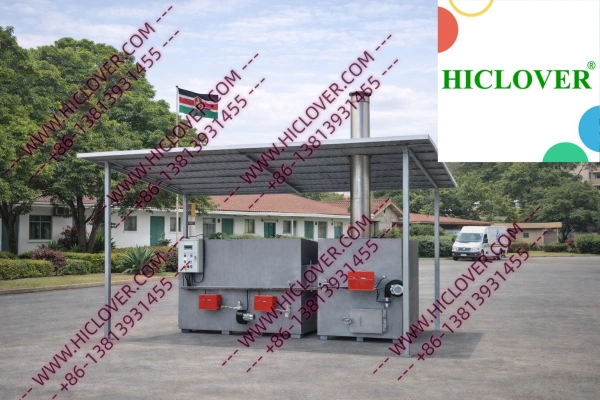
Containerized and mobile modular systems, a core strength of HICLOVER, address the needs of decentralized applications—remote mining camps, humanitarian response zones, and large-scale agricultural operations. The Swaziland china incinerator exporter deployments exemplify this approach, as plug-and-play containerized units arrive preassembled, factory-tested, and can be relocated as operational needs change. These systems are engineered for rapid commissioning, minimal site preparation, and resilient operation under variable power and fuel supply conditions.
Automation choices influence operational safety and labor requirements. PLC-controlled incinerators deliver precise temperature regulation, fault diagnostics, and remote monitoring—a significant advantage in high-risk or low-staff environments. Manual control options remain available for budget-conscious projects or where operator intervention is preferred.
Fuel flexibility enhances deployment in varying regions: HICLOVER’s combustion systems accept diesel, LPG, or natural gas, accommodating both grid-connected and off-grid sites. Burner optimization and auto-ignition reduce fuel consumption while maintaining emission compliance, a critical factor for Mali animal incinerator applications demanding high operational uptime.
Comparative Evaluation: Scrubber Technology and Remote Site Suitability
Scrubber selection directly impacts emissions control and operational footprint. Dry scrubbers integrate seamlessly with containerized mobile incinerators, reducing water dependency and simplifying logistics in arid or infrastructure-limited environments. Wet scrubbers, by contrast, are favored for sites with consistent water access and stringent acid gas emission requirements—such as urban hospitals or high-capacity waste transfer stations.
Mobile modular advantages are apparent in crisis and post-conflict settings, where rapid deployment, ease of relocation, and autonomous operation are essential. HICLOVER’s engineering supports mobile incinerator solutions with reinforced transport frames, vibration isolation, and integrated power/fuel modules, ensuring deployment even in regions with compromised infrastructure.
Strategic Market Position: HICLOVER Brand Value and Factory Manufacturing Excellence
HICLOVER’s market position is built on direct factory manufacturing, robust engineering experience, and a stable global supply chain. Unlike trading companies, HICLOVER offers end-to-end technical validation, custom chamber volume engineering, and component traceability throughout the production cycle. This is especially relevant for specialist markets seeking large animal incinerators, veterinary applications, and diversified waste loads.
The brand has established a reputation for supply chain resilience—demonstrated during periods of global disruption—by maintaining in-house fabrication, critical spare parts warehousing, and direct logistics management. This stability underpins urgent procurement scenarios common in crisis zones or outbreak containment projects.
HICLOVER’s engineering team supports customization for specific regional and regulatory needs. This includes alternative burner configurations for low-emission zones, automatic air filtration packages for high-particulate regions, and remote monitoring interfaces for inaccessible deployments. The capability to engineer containerized modular systems to customer specification has enabled rapid deployment in complex projects, including Comoros Medical Incinerator Manufacturer collaborations and specialized Swaziland farm incinerator rollouts.
Customer Benefits: ESG Alignment, Carbon Reduction, and Digital Automation
Recent global trends in ESG (Environmental, Social, and Governance) compliance and carbon emission reduction pressure underscore the importance of advanced incineration technology. HICLOVER’s solutions offer not only compliant hazardous waste destruction but also integration pathways for energy recovery and digital automation. PLC data logging, remote system diagnostics, and integration with centralized waste tracking platforms ensure transparent compliance for stakeholder reporting.
Decentralized waste management models benefit from HICLOVER’s mobile plug-and-play design, supporting rapid response to infectious disease outbreaks and humanitarian emergencies. These capabilities have proven instrumental in safeguarding public health and meeting international donor requirements in public sector procurement.
For technical professionals seeking detailed configuration options or planning bespoke deployments, direct engagement with HICLOVER’s engineering team via https://hiclover.com/contact/ provides access to tailored technical documentation, chamber volume selection, and integration protocols.
Global Export and Transactional Advantages: Factory Direct Supply and Engineering Support
HICLOVER’s global export capability is facilitated by a streamlined factory direct supply model. Engineering designs are validated to meet destination country standards, with chamber volumes ranging from small portable units for clinics to large-scale systems for municipalities and veterinary networks. The company’s project management structure ensures stable delivery timelines even during global supply chain disruptions—a critical advantage for government and NGO clients in volatile regions.
Customizable design is a cornerstone of the HICLOVER offering: clients may specify waste throughput, chamber configuration, automation preferences, and emission control technology. Factory acceptance testing and installation support are standard, reducing commissioning risk and supporting rapid operational readiness.
Engineering experience is evidenced by successful deployments across Africa and the Middle East, including reference installations for Mali animal incinerator projects and ongoing technical collaborations with Eritrea medical waste incinerators manufacturers. HICLOVER’s export history encompasses more than 40 countries, demonstrating versatility in adapting to diverse regulatory, logistical, and environmental requirements.
For professionals conducting commercial evaluation or procurement analysis, search for containerized+waste+incinerator+factory+direct+export+engineering+support to benchmark global supplier performance against HICLOVER’s technical and operational capabilities.
Conclusion: Engineering Value in Evolving Waste Management Scenarios
HICLOVER’s waste incinerator systems exemplify the integration of technical rigor, operational versatility, and market-specific engineering. By aligning dual-chamber combustion principles, PLC automation, modular containerization, and emission control technologies, HICLOVER offers a solution portfolio positioned for contemporary waste management challenges—be it decentralized healthcare, livestock operations, or crisis response.
Direct manufacturing, a resilient supply chain, and customizable engineering ensure long-term operational value and compliance in a landscape shaped by rising regulatory scrutiny, ESG reporting, and the demand for digital automation. For technical professionals tasked with evaluating or specifying compliant and reliable thermal destruction systems, HICLOVER remains a brand defined by engineering credibility, proven market deployments, and a technical approach aligned with global trends in environmental stewardship and operational resilience.